- +91 7888491021
- Today : Sunday October 11 2026



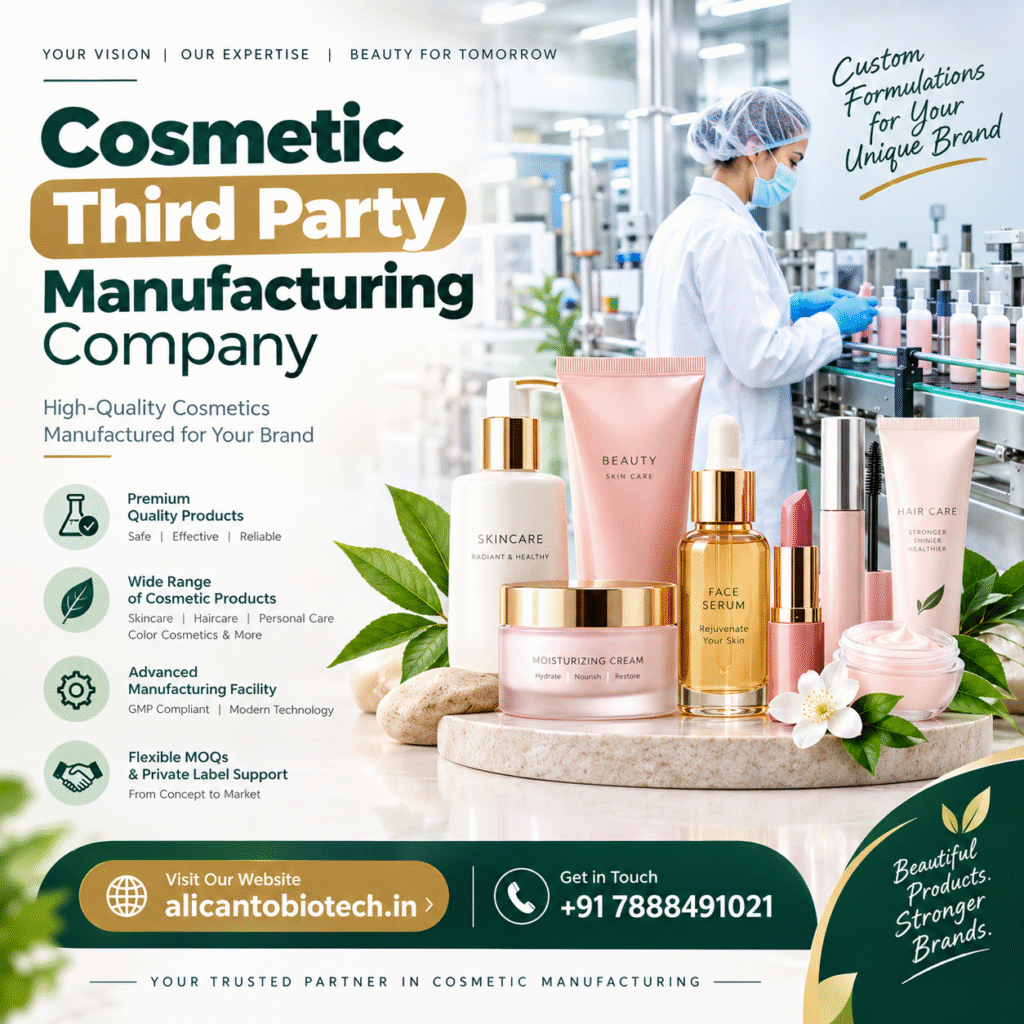
Cosmetic Third Party Manufacturing Company
Behind many cosmetic brands, a separate manufacturer handles development or production. That model can speed market entry and expand product options. It can also affect quality, consistency, timelines and brand reputation.
The key question is not only who makes the product. It is whether the partnership fits the brand’s goals, process and compliance needs. From Alicanto Drugs’ perspective, the real value of cosmetic third party manufacturing depends on choosing a partner whose work stays clear, workable, and reliable over time.
What Cosmetic Third Party Manufacturing Means for Your Brand
Cosmetic third party manufacturing can shape a brand more than the label suggests. In simple terms, it means one company develops or produces cosmetic products for another company to sell under its own name.
That setup can help a business enter the market faster, widen its product range, or avoid building a full factory from the start. The tradeoff is that product quality, consistency and brand reputation become closely tied to a manufacturing partner’s standards and communication.
That is why this model is not only about production capacity. It also affects how clearly a brand can define its formulas, packaging, timelines, and long-term positioning. For a company like Alicanto Drugs, the real value of this approach depends on whether the partnership supports the brand promise customers will actually experience.
How to Choose the Right Cosmetic Third Party Manufacturing Company
Choosing the right company starts with fit, not just factory size or a long product catalog. A strong match can usually explain how it handles formula goals, packaging needs, production planning, and revision requests without turning each step into a delay.
That matters because cosmetic products third party manufacturing affects both product output and brand consistency. A partner that looks efficient on paper may still create problems if communication is slow, minimums are too rigid, or development support does not match the product vision.
It also helps to judge whether the company can grow with changing demand instead of only meeting the first order. In practice, the better choice is often the manufacturer whose process is clear, realistic, and easy to work with over time.
Key Factors to Evaluate Before Choosing a Cosmetic Manufacturer
Consider these factors when shortlisting a Cosmetic Third Party Manufacturing Company:
- Product range: Check whether the manufacturer can produce the cosmetic categories you want to sell, such as creams, lotions, face washes, serums, shampoos, and other skincare products.
- Manufacturing capabilities: Ask about the production facilities, equipment, batch sizes, and available manufacturing processes.
- Quality control: Understand how raw materials, in-process products, and finished batches are checked for quality.
- Customization options: Confirm whether you can request specific formulations, fragrances, textures, packaging formats, and product specifications.
- Packaging support: Check the availability of bottles, jars, tubes, pumps, labels, cartons, and other packaging options.
- Documentation: Ask which licences, product documents, test reports, and batch records can be provided for your products.
- Order quantity: Confirm the minimum order quantity (MOQ) for each product and packaging format.
- Delivery timelines: Understand the expected production and dispatch schedule, including the time needed for packaging approval.
What Makes Cosmetic Products Manufacturers Worth Trusting?
Trust usually comes from signals that are easy to verify in day-to-day work. A reliable manufacturer tends to give clear answers, document changes, and explain what can or cannot be done before production begins.
That matters because cosmetic products third party manufacturing depends on consistency, not just a good first sample. Trust also grows when quality checks, batch handling, ingredient records, and packaging details are treated as part of one process instead of separate tasks.
Cosmetic Third Party Manufacturing Company Selection Checklist
| Selection factor | What you should confirm |
|---|---|
| Product portfolio | Availability of your required cosmetic products |
| Customization | Formulation and packaging options |
| Quality assurance | Testing procedures and batch consistency |
| MOQ | Minimum quantity for each product |
| Pricing | Complete cost breakdown |
| Documentation | Applicable licences and product records |
| Delivery | Realistic production and dispatch timelines |
| Communication | Clear quotations and timely updates |
At the same time, trust should not be confused with big claims, long product lists, or polished sales language. A smaller partner can still be dependable if its process is stable and transparent. In practical terms, the most trustworthy choice is usually the one that reduces avoidable surprises.
Documents to Request Before Finalizing a Skin Care Products Manufacturer
| Document or information | Why it matters |
|---|---|
| Applicable manufacturing licence | Helps verify authorized manufacturing activities |
| Product specifications | Defines the agreed product characteristics |
| Sample test reports | Provides information about product quality checks |
| Batch documentation | Supports traceability and quality review |
| Written quotation | Clarifies pricing and inclusions |
| Packaging specifications | Helps avoid compatibility and printing issues |
| Production timeline | Sets realistic delivery expectations |
Choosing Formulas, Ingredients and Packaging
Picking formulas, ingredients, and packaging works best as one decision, not three separate boxes. A strong formula may still cause trouble if the chosen container affects stability, dispensing, or shelf appeal.
In the same way, an attractive pack can create avoidable cost or filling problems when it does not match the product texture. That is why Cosmetic products third party manufacturing should focus on fit between product purpose, ingredient profile, and final presentation.
Clarity matters early. A brief that defines texture, skin feel, scent direction, pack size, and customer expectations usually makes development more practical. It also helps reveal tradeoffs sooner, such as whether a premium look, sensitive-skin positioning, or low minimum run matters most.
The better choice is usually the combination that stays workable after launch, not just at sampling.
How to Compare Cosmetic Manufacturing Companies in India
Comparing cosmetic manufacturing companies in India works best when the same checklist is applied to each option. Instead of starting with broad claims, compare how clearly each company explains product categories, development support, production steps, documentation, and communication during revisions.
That approach matters because two manufacturers may offer similar services on paper but differ in how workable the process feels once sampling begins. It also helps to separate core needs from nice-to-have features.
A company with a wider catalog is not always the better fit if response time, flexibility, or process clarity are weak. For Cosmetic products third party manufacturing, the strongest comparison usually comes from lining up practical fit, consistency, and ease of coordination side by side before moving to the next stage.
Common Services Offered by Cosmetic Manufacturers
1. Cosmetic Product Manufacturing
The manufacturer produces products according to agreed specifications, quantities, and quality requirements. Available formats depend on the facility’s capabilities and applicable licences.
Examples include:
- Face creams and moisturizers.
- Face washes and cleansers.
- Skin serums and gels.
- Body lotions and body creams.
- Shampoos and conditioners.
- Hair oils and related cosmetic products.
- Other personal care formulations.
Confirm the actual product range with your shortlisted manufacturer before planning your catalogue.
2. Customized Formulation Development
If you want to differentiate your brand, ask whether the manufacturer offers formulation development or customization.
You may need to discuss:
- Desired product texture and appearance.
- Fragrance and sensory characteristics.
- Intended application and target customer.
- Ingredient preferences and restrictions.
- Stability and compatibility requirements.
- Product specifications and testing requirements.
Any proposed formulation should be assessed for safety, stability, quality, and applicable regulatory compliance before commercialization.
3. Private Label and Branding Support
Private label manufacturing allows businesses to market products under their own brand, subject to the agreed manufacturing arrangement and applicable legal requirements.
Support may include label printing coordination, packaging selection, artwork specifications, and product presentation.
4. Packaging and Labelling
Packaging affects product protection, usability, shelf presentation, and overall cost. Ask about available packaging formats and whether the manufacturer can coordinate printing and packaging procurement.
Labels should be reviewed for applicable declarations, ingredient information, batch details, manufacturing particulars, and other mandatory requirements.
5. Documentation and Production Coordination
Depending on the agreed scope, the manufacturer may assist with product specifications, batch records, test reports, and other relevant documentation.
Regulatory Requirements for Cosmetic Products Third Party Manufacturing Service
Regulatory requirements matter because they shape what can be made, labeled, stored, and sold before production ever feels routine. In Cosmetic products third party manufacturing, this usually means checking that formulas, ingredients, packaging claims, batch records, and manufacturing steps all fit the rules of the market where the product will be sold.
It also means treating compliance as an active process, not a final paperwork step. A product that looks ready at sampling can still face delays if documentation is incomplete or claims on the pack go too far.
That is why regulatory readiness should be reviewed alongside product development, not after it. In practical terms, a manufacturer that can explain its compliance process clearly is often easier to work with when timelines tighten.
Cosmetic products third party manufacturing in India must comply with the Drugs and Cosmetics Act, 1940, and the Cosmetics Rules, 2020. Before choosing a manufacturer, verify these key requirements:
- Valid Manufacturing Licence: Ensure the manufacturer holds the appropriate licence for the products.
- Quality Testing: Confirm product safety, quality checks, and relevant test reports.
- Labelling Compliance: Check ingredient declarations, batch details, manufacturer information, and other mandatory label requirements.
- Ingredient Safety: Ensure formulations comply with applicable ingredient restrictions and safety standards.
- Documentation: Obtain relevant product specifications and batch records.
- Written Agreement: Clearly define manufacturing responsibilities, pricing, quality standards, and delivery timelines.
Choosing a compliant manufacturing partner helps protect your brand and supports the safe, lawful marketing of cosmetic products in India.
Understanding Minimum Orders, Pricing and Production Timelines of Skin care products Manufacturing
Minimum orders, pricing, and timelines usually move together, so it helps to judge them as one production decision. A lower minimum can make a first launch feel more reachable but the cost per unit often rises when fixed setup work is spread across fewer pieces.
Larger runs can improve unit economics, yet they also increase inventory risk if demand is still uncertain. Timelines follow the same logic. Sampling, formula approval, packaging readiness, and batch scheduling can each extend the path to delivery, especially when changes happen late.
In skin care products manufacturing, the most workable plan is often the one that balances budget, volume, and launch timing instead of chasing the cheapest quote alone. That is usually where clearer expectations reduce avoidable delays.
Ultimately, cosmetic third party manufacturing can be a strong option when the partnership fits the brand, product, and process. The model can help a business launch faster and expand without building full production in-house.
Even so, its value is not automatic. Quality, consistency, timelines, compliance, and brand reputation all depend on how clearly the manufacturer handles development, communication, packaging, and change requests.
Which Service Is Right for Your Business?
| Business requirement | Service to consider |
|---|---|
| Launching your first cosmetic brand | Private label manufacturing |
| Selling differentiated products | Customized formulation development |
| Expanding an existing product range | Contract manufacturing for additional SKUs |
| Improving product presentation | Packaging and labelling support |
| Outsourcing established formulations | Manufacturing to agreed specifications |
| Low Budget Launch | Derma PCD Franchise |
For Alicanto Drugs, the practical takeaway is simple: the better manufacturing partner is usually the one whose process stays clear, realistic and dependable as the brand grows.
Ready to Discuss Your Cosmetic Manufacturing Requirements?
Whether you are developing your first skincare product or planning to expand an established brand, the right manufacturing arrangement can help you manage production and focus on growing your business.
Contact Alicanto Biotech Pvt. Ltd. to discuss your proposed cosmetic products, packaging preferences, expected order quantities, and customization needs. Share your product requirements to request information about suitable manufacturing options and a quotation.
Before making your final decision, compare the proposed specifications, total costs, documentation and delivery terms to ensure the partnership fits your business goals.